A First-Timer’s Guide to Septic System Maintenance
Quick answer: A septic system is a tank plus a drainfield. Wastewater from the house flows to the tank, solids settle, and liquid goes out to the soil. Your job, for everyday septic system maintenance, is to find the lids, pump the tank on a real schedule, keep the outlet filter clean, and only buy parts that fit what you already have. Start with the checklist below, then use the linked guides for the details.
We may earn a commission if you buy through links on this page, at no extra cost to you. Full disclosure and sources are at the bottom of the page.
How does a septic system work?
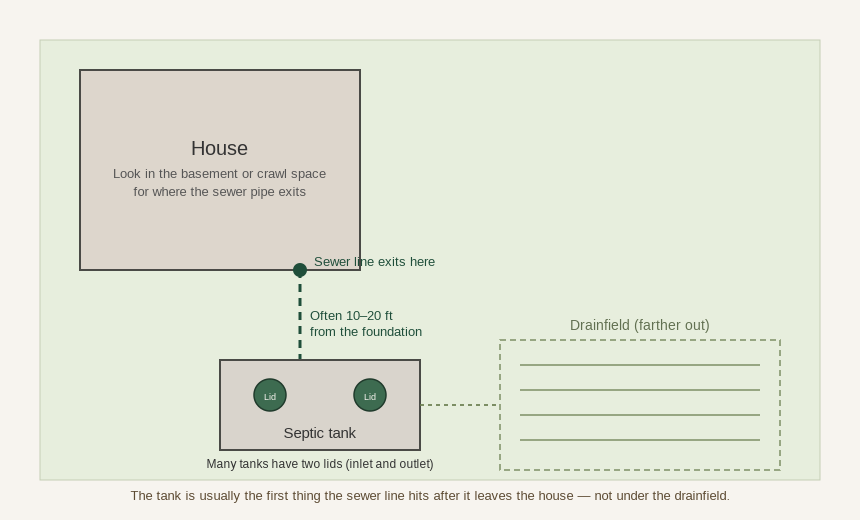
- A sewer pipe leaves the house and enters the septic tank.
- Inside the tank, scum floats, sludge sinks, and clearer liquid sits in the middle.
- That liquid leaves through an outlet tee—often with an effluent filter—to the drainfield.
- The drainfield is not a second tank. It is soil that finishes the treatment. Protecting it is the point of pumping and filters.
Many tanks have two lids, one at each end. You may need both for a proper pump-out. This overview is the map; the how-to pages below are the instructions.
What should a new owner do first?
Work through these in order. You do not have to buy anything on day one.
- Find the lids — and mark them so you can find them again. How to find your septic tank lid
- Check the lids for safety. A cracked, loose, or missing cover is a fall and gas hazard. Septic tank lids and covers
- Learn when to pump. EPA’s typical range is every 3 to 5 years, but household size and tank size can shorten that. How often to pump your septic tank
- Find the effluent filter under the outlet lid and plan to clean it when the tank is inspected or pumped. Effluent filter cleaning and replacement
- If lids are buried, decide whether a riser is worth it so you are not digging every visit. Do I need a septic riser?
- If you decide you need a riser, measure the opening and the height to grade before you order. How to measure for a septic tank riser kit
- Compare kits only after you have those two numbers. Risers for septic tanks: the best kits and how to pick one
- If the system has a pump or lift chamber, confirm there is a working septic alarm.
- Skip tank “treatments.” EPA does not recommend additives as a substitute for pumping. Septic tank additives: do they work?
What is worth buying?
This hub does not repeat the full product tables. Those live on the buying pages, so you do not get three competing lists for the same part.
- Buried lids, mid-20-inch opening, about 18 inches down: start with the Aero-Stream AS-R19 complete riser kit, about $404 as of Nov 2026, check current price, on the riser buying guide.
- Cracked plastic lid on an existing riser: buy a lid that matches the brand and diameter, not a generic “24-inch” cover. Picks start around $42. See lids and covers.
- No filter, or a damaged 4-inch cartridge: 4-inch residential filters we priced run about $57–$90. See effluent filters.
- Pump tank with no reliable high-water warning: a 120-volt Sump Alarm 10-foot kit is about $130 as of Nov 2026; an indoor Little Giant mechanical-float alarm is about $164 as of Nov 2026; a battery-powered Aero-ALERT starts about $301 as of Nov 2026. See septic alarms.
Prices were last checked on November 27, 2026 (America/Chicago). Always check the current price.
What are the compatibility rules?
- If you have not measured the tank opening and the height to grade, then do not order a riser kit yet. Measure first.
- If a lid is already at grade and only the cover is bad, then buy a matching lid, not a whole riser.
- If the lid is a cracked concrete plug and there is no riser, then a plastic riser lid will not drop onto the tank. You need a kit with an adapter, or a pro.
- If your outlet tee is not 4 inches, then do not order the 4-inch filters on the filter page.
- If a product promises you can skip pumping, then ignore it and follow EPA’s pumping guidance instead.
When should you call a pro?
Call a licensed pumper or installer, and check local rules, if any of these are true:
- You cannot find the tank, or a lid is missing and you cannot cover the opening safely.
- Sewage is backing up, pooling in the yard, or you smell it outdoors.
- The tank is under a driveway, the concrete around the opening is failing, or you need electrical work for a pump or alarm.
- You are not comfortable working over an open tank.
Never enter a septic tank. Tanks can hold dangerous gases. Nothing on this site is legal, code, or engineering advice.
Frequently asked questions
I just bought a house with a septic system. What is the first thing I should do?
Find the lids, get the last pump-out date if you can, and schedule an inspection if that date is missing or more than a few years old. Use the checklist above.
How often should a first-time owner pump the tank?
Start with EPA’s 3-to-5-year range, then tighten it with the household-size table on the pumping page. A 1,000-gallon tank and four people is often closer to every two to three years.
Do I need a riser, a new lid, and a filter all at once?
No. Make the tank safe and findable first. Add a riser if you are tired of digging. Add or replace a filter if the outlet has no working screen. Buy only what fits.
Are septic treatments worth it for a new owner?
EPA says no for household systems. Spend that money on pumping and a filter that fits.
Related guides
All of the how-to and buying pages on this site are linked in the checklist above.
Sources and notes
Affiliate disclosure: Some links on this page will be affiliate links. If you buy through them, we may earn a commission at no extra cost to you. We have not tested these products. Full product specs and citations live on the buying and how-to pages linked above.
Last checked: November 27, 2026 (America/Chicago).